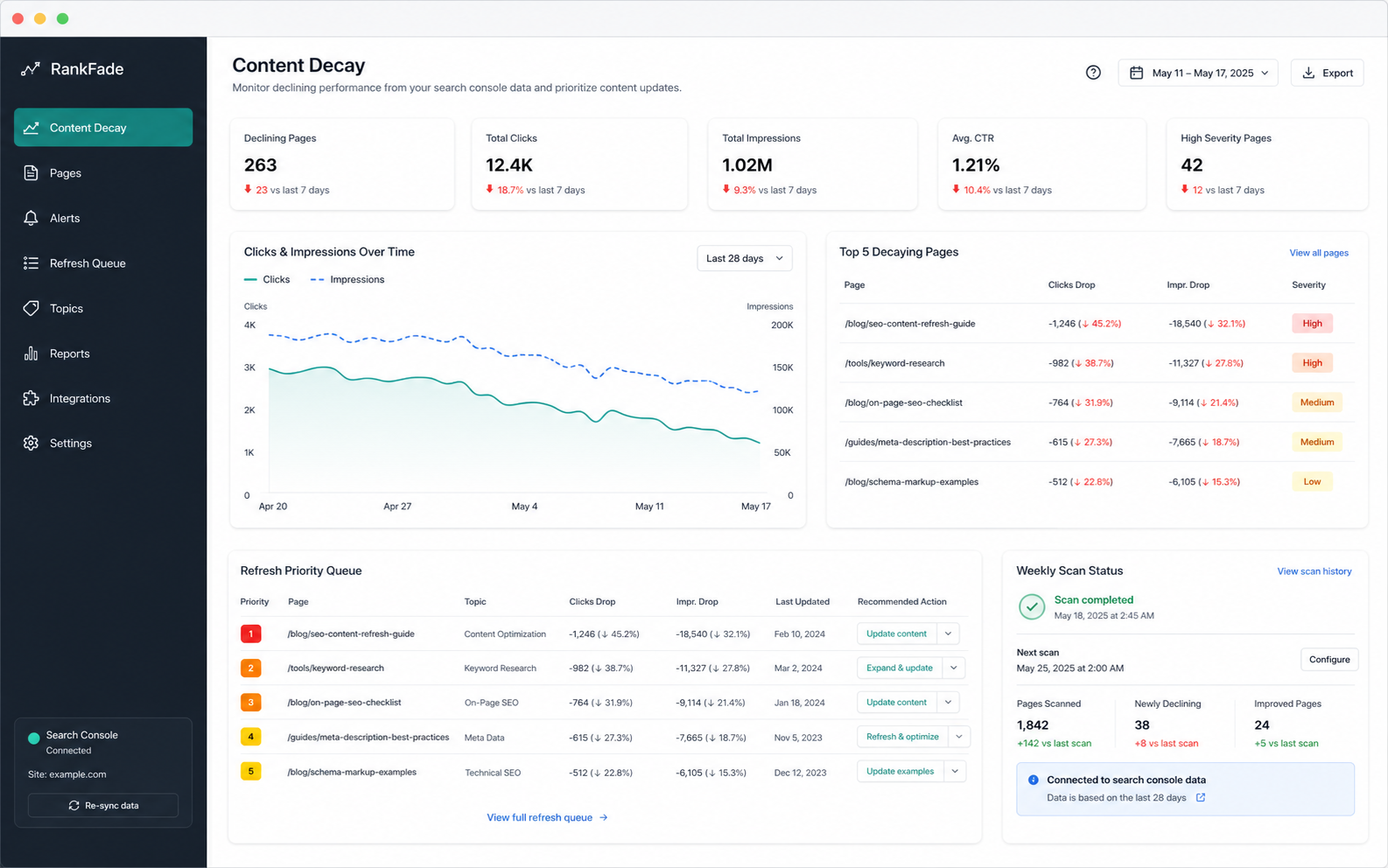
Refreshing always loses to publishing
On a content calendar, new posts are concrete and refreshes are vague. "Update old content" has no owner, no priority, and no deadline, so it slides week after week while the back catalog quietly decays. The problem isn't discipline — it's that refreshing has never had a clear, ranked input the way new production does.
Give the team a specific list of which pages to update and why, and refreshing stops competing on vibes and starts competing on numbers.
RankFade feeds your planning
RankFade connects to Google Search Console and produces the input your editorial process is missing:
- A ranked refresh queue. Every decaying page, ordered by the clicks at stake, so the top five items are an obvious agenda for the week.
- Baseline-aware detection that filters out seasonal noise, so writers spend time on pages that are genuinely declining — not on false alarms.
- A clear hand-off. Each item comes with the queries and traffic behind it, so a writer can start a refresh without an analyst's spreadsheet.
Routing the top priorities straight into weekly planning makes refreshing a measurable lane alongside new work, with its own visible ROI.
Make it a routine
The workflow becomes repeatable: pull the top queue items into the sprint, refresh them to match current intent, publish, and let RankFade confirm the recovery. Read the method on the content decay monitor page, see how scoring works on SEO refresh priority, or follow the manual playbook in the content decay checklist. Pricing starts free for the first property.